
Abu Simbel Temple Guide: How to Visit, Tickets & History
Planning an Abu Simbel visit from Aswan? This practical Abu Simbel guide explains how to get there, what the two temples mean, current entrance prices, opening hours, the best time to visit, and how to plan the trip without wasting time.
If you are searching for an Abu Simbel guide, you probably want more than a history lesson. You need to know whether Abu Simbel is worth the long journey from Aswan, how early you should leave, what the tickets cost, how much time to allow, and what you will actually see when you arrive.
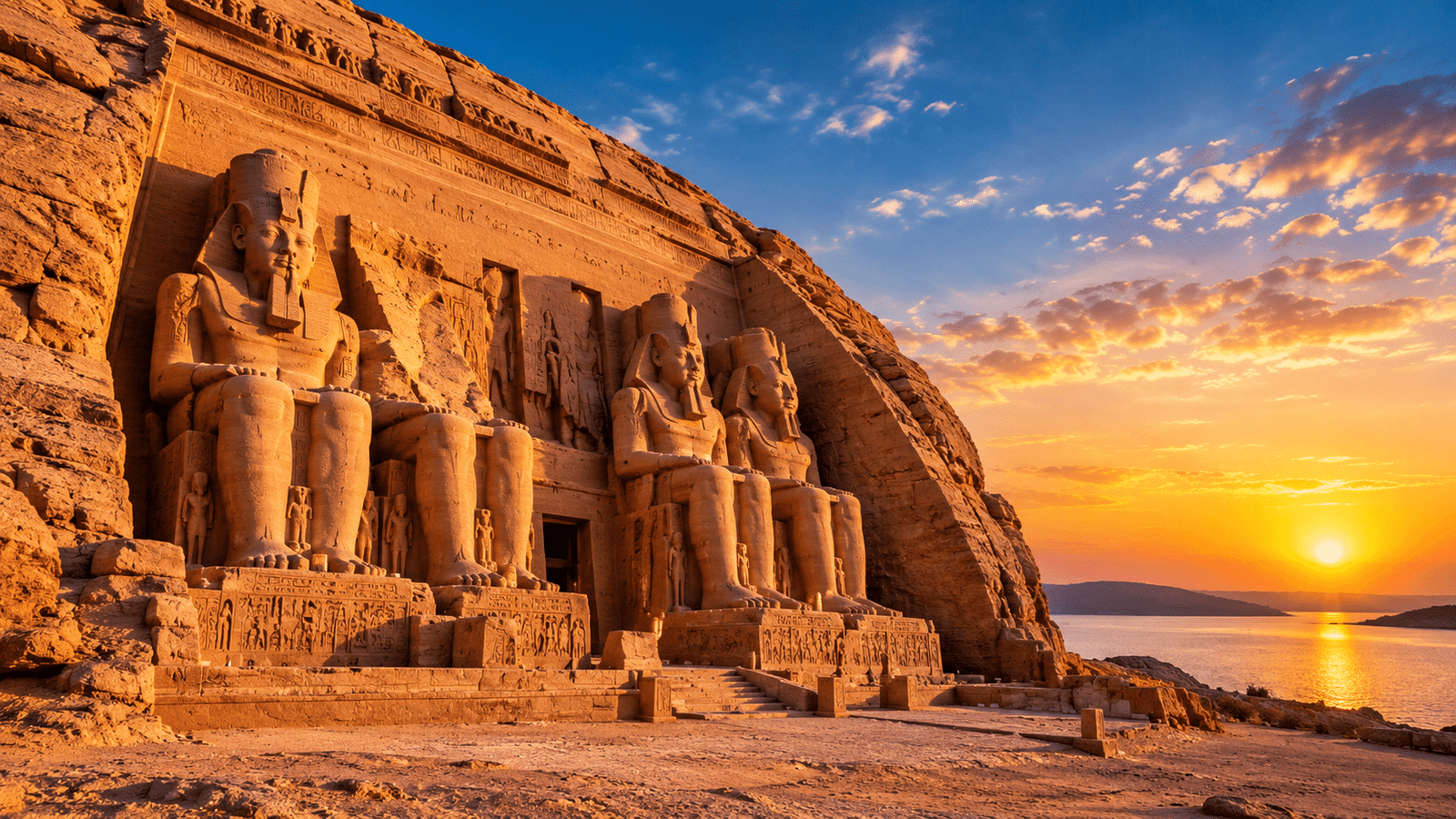
Abu Simbel is one of the most remarkable ancient sites in southern Egypt. The complex contains two rock-cut temples built during the reign of Ramesses II: the Great Temple, dominated by four enormous royal statues, and the smaller temple dedicated to Queen Nefertari and the goddess Hathor. Both monuments were later relocated to protect them from the rising waters created by the Aswan High Dam.
The key to enjoying Abu Simbel is planning. The temples are far south of Aswan, so the experience is very different from visiting a group of monuments located within one city. A well-timed morning visit can make the journey feel straightforward, while a poorly planned trip can mean a very early departure, long transfers, and too little time inside the temples.
Why Visit Abu Simbel?
Abu Simbel is not simply another ancient Egyptian temple. Its scale, setting, and history make it one of the most memorable stops you can add to an Aswan itinerary.
The first thing you notice is the Great Temple façade. Four colossal seated figures of Ramesses II dominate the entrance, each carved from the living rock. The official Egyptian tourism portal describes the statues as approximately 20 meters high. Once you pass through the entrance, the monument becomes an interior journey through monumental halls, reliefs, columns, and finally the sanctuary.
There is also a second reason to visit: Abu Simbel tells an unusually modern story about ancient heritage. The temples you see today are not standing in their original location. They were dismantled and moved in the 1960s as part of a major international campaign to save Nubian monuments from the waters of Lake Nasser. The relocation was completed in 1968.
Abu Simbel History in Simple Terms
The Great Temple of Abu Simbel was commissioned by Ramesses II during Egypt’s 19th Dynasty. The temple was carved into the rock and dedicated to several major deities, including Amun-Ra, Ra-Horakhty, Ptah, and the deified Ramesses II himself.
The location was not accidental. Abu Simbel stood in ancient Nubia, far south of Egypt’s traditional political centers. A huge royal monument in this region communicated power to people traveling through the southern frontier and reinforced Ramesses II’s royal image.
The smaller temple was dedicated to Hathor and Queen Nefertari, the Great Royal Wife of Ramesses II. One of its most striking details is the scale of Nefertari’s statues on the façade. Unlike many royal monuments where the queen’s representation is visibly smaller than the king’s, the statues of Nefertari at Abu Simbel are presented at a comparable monumental scale.
Inside the Great Temple, the decoration also provides an important window into royal propaganda. Scenes show Ramesses II in connection with military campaigns and religious rituals. The monument therefore worked as both a sacred space and a statement about kingship.
The Two Abu Simbel Temples
1. The Great Temple of Ramesses II
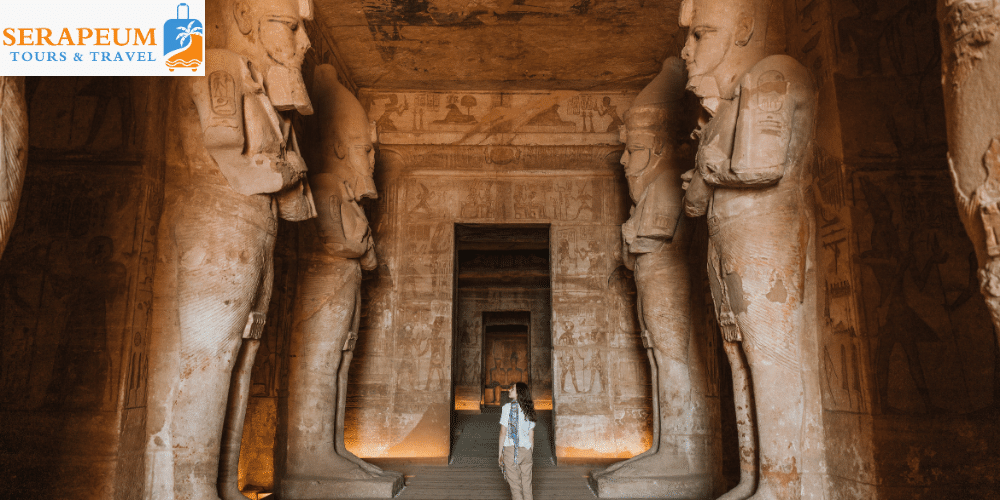
The Great Temple is the larger and more dramatic of the two monuments. Its façade is immediately recognizable because of the four colossal seated statues of Ramesses II. One of the statues was damaged by an ancient earthquake, and its fallen fragments remain visible near the entrance.
Inside, the route takes you through a monumental hypostyle hall with large statues of the king. Further chambers lead toward the sanctuary, where four divine figures are represented. The arrangement was designed to create a powerful progression from the enormous exterior façade to the increasingly sacred interior spaces.
2. The Small Temple of Nefertari
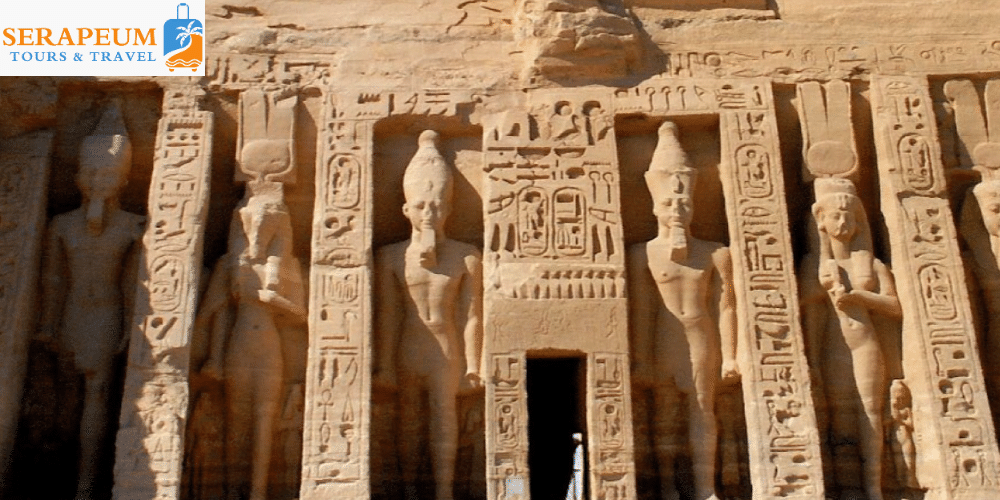
The second monument is smaller but should not be skipped. It was built for Hathor and Queen Nefertari, and its façade includes statues of both Ramesses II and Nefertari.
For many visitors, the smaller temple provides a useful contrast. The Great Temple emphasizes the king’s authority on a monumental scale, while the Small Temple gives more attention to the royal relationship between Ramesses II and Nefertari and to the goddess Hathor.
If your visit is part of a guided excursion, ask your guide to explain the relationship between the two temples before entering. That small piece of context can make the visit much easier to understand.
Why Was Abu Simbel Moved?
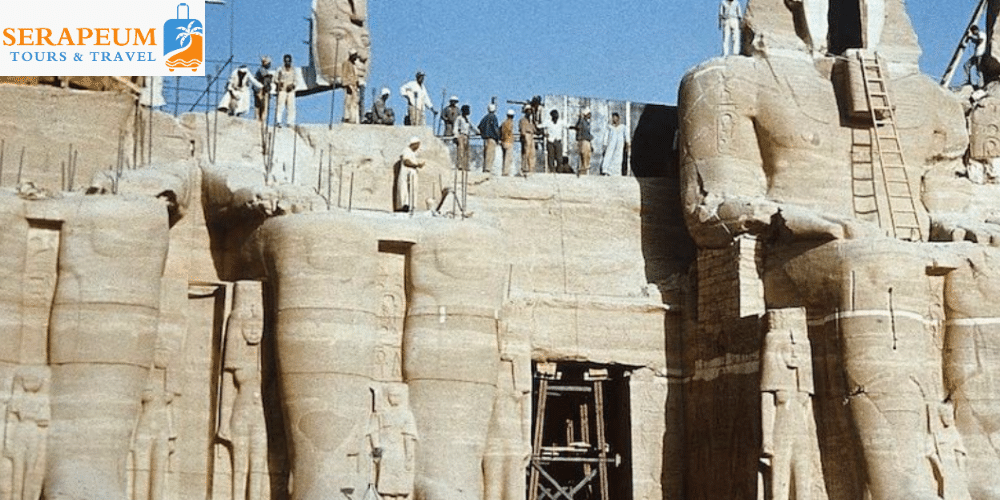
One of the most important facts in any Abu Simbel guide is that the temples were saved from flooding. Construction of the Aswan High Dam caused the waters of Lake Nasser to rise, threatening numerous archaeological sites in Nubia.
An international campaign was organized with UNESCO’s involvement to rescue important monuments. Abu Simbel became one of the most famous examples of this effort. The temples were dismantled into large sections and reconstructed at a higher location nearby. The relocation was completed in 1968.
This explains why Abu Simbel feels so extraordinary from a modern engineering perspective as well as an archaeological one. The monument is ancient, but its survival is partly the result of a large-scale 20th-century conservation project.
The Nubian monuments rescued during this period were later recognized as part of a UNESCO World Heritage Site in 1979.
Abu Simbel Tickets, Prices & Opening Hours
Ticket information is one of the most important practical parts of planning an Abu Simbel visit. The official Ministry of Tourism and Antiquities page currently lists the site as open every day from 6:00 AM to 5:00 PM.
| Visitor Category | Standard Ticket | Sun Alignment Dates |
|---|---|---|
| Foreign adult | EGP 750 | EGP 1,200 |
| Foreign student | EGP 375 | EGP 600 |
| Egyptian adult | EGP 30 | EGP 60 |
| Egyptian student | EGP 10 | EGP 20 |
The Ministry’s current listing also shows separate vehicle charges: EGP 25 for a car or taxi, EGP 50 for a microbus, EGP 75 for a coaster, and EGP 100 for a bus.
Because Egyptian archaeological ticket prices can change, treat these figures as a planning reference rather than a permanent price guarantee. Before traveling, check the official monument listing or the official ticketing information. Egypt’s official tourism FAQ states that archaeological-site tickets can be purchased at the site or online through the Ministry’s official platform.
How to Get to Abu Simbel from Aswan
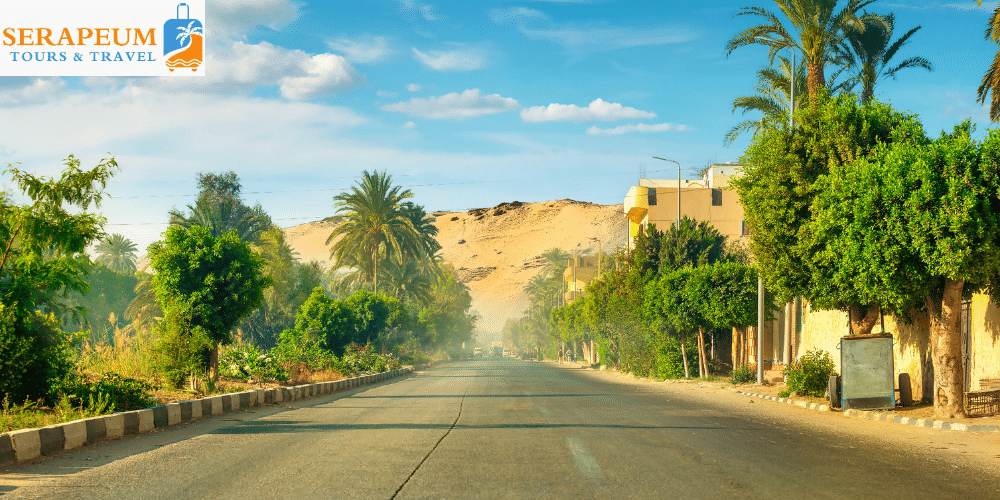
For most travelers, Aswan is the practical base for visiting Abu Simbel. Egypt’s official tourism distance information lists the road distance between Aswan and Abu Simbel at roughly 260 km.
Option 1: Organized day trip
This is the simplest choice for many first-time visitors. A typical organized excursion handles the transportation and timing, allowing you to concentrate on the temples instead of coordinating every part of the journey.
The main advantage is convenience. It can also be useful when your Egypt itinerary includes Cairo, Luxor, and Aswan and you want to avoid adding unnecessary logistical complexity.
Option 2: Private car or private tour
A private transfer gives you more flexibility over departure time and pace. This is particularly useful for travelers who want more time for photography, prefer a less rushed experience, or are traveling as a family or small group.
Option 3: Domestic flight
Flying can significantly reduce the time spent traveling overland, although schedules and availability need to be checked for your specific dates. Egypt’s official tourism FAQ notes that travelers can consult their tour operator or an officially authorized travel agency for details about domestic flights.
| Transport | Best For | Main Consideration |
|---|---|---|
| Organized road trip | Convenience and straightforward planning | Early start and fixed schedule |
| Private transfer | Flexibility and comfort | Usually costs more |
| Domestic flight | Saving overland travel time | Flight schedules and availability |
Can You Visit Abu Simbel as a Day Trip?
Yes. A day trip from Aswan is one of the most common ways to visit Abu Simbel, and it works well when your itinerary is tight.
The important point is to think of Abu Simbel as a full excursion rather than a short sightseeing stop. The temples themselves can be visited in a few hours, but the return journey to Aswan makes the overall day considerably longer.
If you have only one day available, prioritize the Great Temple and Small Temple and avoid filling the same day with several unrelated Aswan attractions. If you have two days in Aswan, placing Abu Simbel on one day and the Aswan attractions on another usually creates a more comfortable rhythm.
How Long Do You Need at Abu Simbel?
For the temples themselves, plan on roughly 1.5 to 2.5 hours depending on your pace, interest in the reliefs, photography time, and whether you are traveling with a guide.
History enthusiasts may want longer. First-time visitors who mainly want to see the major monuments can usually experience the highlights without spending an entire day inside the archaeological site.
The bigger time commitment is the journey from Aswan. That is why your transport choice matters more than shaving 20 minutes off the temple visit.
A practical visit rhythm
- Arrive with enough time to enter without rushing.
- Start with the Great Temple and spend time on both the exterior and interior.
- Visit the Small Temple of Nefertari and Hathor.
- Leave time for photographs outside the temples.
- Keep water, sun protection, and comfortable footwear accessible.
- Allow enough buffer for the return journey to Aswan.
Best Time to Visit Abu Simbel
The best time depends on what you value most: comfortable temperatures, smaller crowds, or the famous solar alignment.
For comfortable sightseeing
Cooler months are generally more comfortable for southern Egypt, especially if you are combining Abu Simbel with outdoor sightseeing in Aswan. Winter mornings can be particularly pleasant, although the desert environment means you should still prepare for strong sunlight.
For fewer crowds
Timing your arrival early can help you avoid the busiest part of the visitor flow. Early morning also gives you softer light for exterior photography and avoids the strongest heat later in the day.
For the famous solar alignment
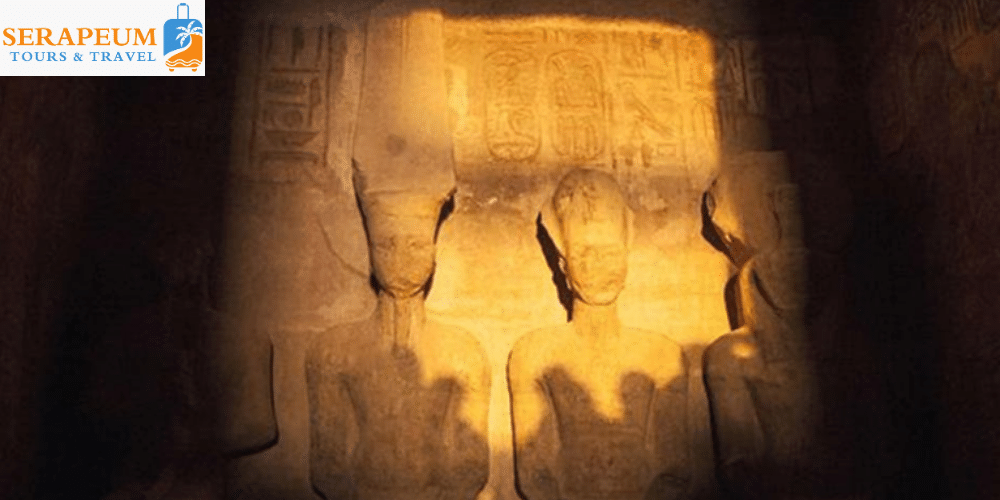
The Great Temple is famous for a solar phenomenon associated with February 22 and October 22. On these dates, sunlight enters the temple and reaches the inner sanctuary. The Ministry of Tourism and Antiquities identifies these two dates in its official description of Abu Simbel.
These dates are special but also require more careful planning. Demand can be different, ticket prices are currently listed higher, and you should verify the exact arrangements before building your itinerary around the event.
The Abu Simbel Sun Alignment: What Makes It Special?
The solar alignment is one of the most famous features associated with Abu Simbel. According to Egypt’s Ministry of Tourism and Antiquities, sunlight enters the Great Temple on February 22 and October 22, crosses the interior spaces, and illuminates figures in the sanctuary.
It is easy to think of the phenomenon as simply a photographic event, but it is more interesting when considered as part of the temple’s architectural design. The alignment demonstrates how ancient builders integrated the orientation of the monument with the movement of the sun.
If seeing the alignment is one of your main reasons for visiting, do not treat it like a normal Abu Simbel day trip. Confirm the date, entry arrangements, ticket price, transport, and expected crowd conditions well in advance.
What to Look for Inside Abu Simbel
The four colossal statues
Before entering, spend a few minutes looking carefully at the façade. The four seated figures are the visual signature of Abu Simbel, but details around the monument are easy to miss when visitors immediately start taking photographs.
The damaged statue
One of the four colossal statues was damaged in antiquity, and its fallen fragments can still be seen. This provides a physical reminder that the monument has experienced earthquakes and other changes over its long history.
The hypostyle hall
The Great Temple’s interior opens into a large hall containing monumental representations of Ramesses II. Look upward as well as straight ahead; the ceiling decoration contributes to the sense of scale.
The sanctuary
The innermost sanctuary contains representations of Amun-Ra, Ra-Horakhty, Ptah, and the deified Ramesses II. The gradual movement from the bright exterior to the more enclosed sacred spaces is an important part of the architectural experience.
The Small Temple
Do not let the word “small” convince you that this temple is optional. Its façade, connection with Nefertari and Hathor, and different visual character make it an important part of the Abu Simbel visit.
Abu Simbel Cost & Budget Planning
Your total Abu Simbel budget is more than the archaeological entrance ticket. The final cost depends heavily on how you travel from Aswan and whether you use a private guide or an organized excursion.
| Expense | What to Consider |
|---|---|
| Temple entrance | Current official ticket prices should be checked before travel. |
| Transportation | Road transfers, private cars, organized tours, or flights can produce very different total costs. |
| Guide | Optional, but useful if you want the reliefs and symbolism explained in context. |
| Food and drinks | Carry water and consider food arrangements when leaving Aswan early. |
| Extra time | A private itinerary may cost more but can reduce pressure on a long travel day. |
A useful budgeting principle is to compare the total experience, not just the cheapest transport price. A slightly more expensive option may save substantial time or make the long journey more comfortable.
Practical Abu Simbel Travel Tips
- Start early. A morning visit is usually easier to manage in the southern Egyptian climate.
- Wear comfortable shoes. You will be walking between the temples and standing for much of the visit.
- Bring water. The environment around Abu Simbel is dry and sunny.
- Use sun protection. Sunglasses, a hat, and sunscreen are practical rather than optional luxuries.
- Carry your ticket information securely. Keep digital and physical booking details accessible.
- Do not plan too tightly afterward. The distance from Aswan makes buffer time useful.
- Ask about photography rules. Egypt’s official tourism FAQ states that personal photography and video are generally permitted at archaeological sites, while professional/commercial photography can require permits and certain locations have additional restrictions.
- Consider a guide. The carvings become much more meaningful when you understand what they represent.
- Check official prices shortly before your trip. Archaeological ticket prices and operating arrangements can change.
- Keep your itinerary flexible. Abu Simbel is far enough from Aswan that a little extra planning can make a big difference.
Safety & Comfort Tips for Abu Simbel
Abu Simbel is a major archaeological attraction, but the southern desert environment requires sensible preparation. The most common comfort issues are usually related to heat, sun exposure, dehydration, and the length of the journey rather than the temples themselves.
- Drink water regularly throughout the excursion.
- Protect yourself from direct sun, especially around the exterior of the temples.
- Keep essential medication and personal items with you rather than in the vehicle.
- Follow the instructions of your guide and local authorities.
- Use reputable transport and authorized tourism providers.
- If you are traveling independently, share your itinerary with someone you trust.
For general tourism assistance in Egypt, the official Experience Egypt FAQ lists the Tourism Police emergency contact as 126.
Plan Your Abu Simbel Visit as Part of Your Egypt Itinerary
Abu Simbel works particularly well when it is planned as part of a broader southern Egypt itinerary rather than treated as an isolated attraction.
If you are visiting Aswan, consider how Abu Simbel fits with Philae Temple, the Nubian villages, the Unfinished Obelisk, and other local experiences. If your trip continues north toward Luxor, give yourself enough flexibility to enjoy both destinations instead of turning every day into a rushed transfer.
✈️ Planning Your Egypt Trip?
Planning your trip? Check our complete Egypt Travel Guide.
You can also explore top destinations and travel ideas from our Plan Your Egypt Trip page.
Ready to organize your trip? Visit our Egypt Travel Guide 2026: Everything You Need to Know page to get started.
Travelers who are building a longer Nile Valley itinerary may also find our Luxor Travel Guide: Temples, Tombs & Tips for First-Time Visitors useful when deciding how to divide their time between Aswan and Luxor.
If you are traveling internationally, it is also useful to review the latest Egypt Visa Requirements 2026: Complete Guide for All Nationalities before finalizing your trip.
Abu Simbel FAQ
Yes, Abu Simbel can be a major highlight of a southern Egypt itinerary. The temples are famous for their monumental architecture, connection with Ramesses II and Nefertari, and the remarkable story of their relocation.
Egypt’s official tourism distance information lists the distance between Aswan and Abu Simbel at approximately 260 km. The actual journey time depends on transportation, road conditions, stops, and your itinerary.
The Ministry of Tourism and Antiquities currently lists the foreign adult ticket at EGP 750 and the foreign student ticket at EGP 375. Higher prices are currently listed for February 22 and October 22. Always verify the official price before visiting.
The official Ministry listing currently shows Abu Simbel open daily from 6:00 AM to 5:00 PM. Operating information can change, so checking the official listing shortly before your visit is recommended.
Most visitors should allow around 1.5 to 2.5 hours for the archaeological site, depending on their pace. Remember to allow much more time for the journey from Aswan and back.
Yes, independent travel is possible, but transportation logistics require more planning because Abu Simbel is far from Aswan. A private transfer or organized excursion can simplify the experience.
The larger Great Temple was built by Ramesses II and dedicated to several deities including Amun-Ra, Ra-Horakhty, Ptah, and the deified king. The Small Temple was dedicated to Hathor and Queen Nefertari.
The temples were threatened by the rising waters associated with the construction of the Aswan High Dam. An international UNESCO-led campaign relocated them, with the work completed in 1968.
The famous solar alignment occurs on February 22 and October 22 according to the Egyptian Ministry of Tourism and Antiquities. Travelers planning specifically around these dates should verify current arrangements and ticket prices before booking.
Final Thoughts: Is Abu Simbel Right for Your Egypt Trip?
Abu Simbel requires more planning than many of Egypt’s major attractions because of its distance from Aswan. But that distance is also part of what makes the experience feel different. You are traveling deep into southern Egypt to reach a monumental site that was deliberately positioned in ancient Nubia and later physically rescued from the rising waters of Lake Nasser.
The best way to approach Abu Simbel is therefore not to rush it. Choose your transport carefully, leave enough time in your schedule, arrive prepared for the sun, and give yourself time to appreciate both temples rather than focusing only on the famous façade.
Whether you are interested in ancient Egyptian history, architecture, photography, or simply want to experience one of Egypt’s most extraordinary monuments, Abu Simbel deserves a thoughtful place in a southern Egypt itinerary.
Official information checked for this guide: Egypt’s Ministry of Tourism and Antiquities currently lists Abu Simbel’s opening hours as 6:00 AM–5:00 PM and provides the current ticket information used in this article. Egypt’s official tourism resources also provide the approximate Aswan–Abu Simbel distance and general travel guidance. Always recheck official information before publication or travel because prices and operating arrangements can change.